
This year's Solstice Vigil project is wordier than most. That's not to say I'm not pleased with the pictures. As years go, I'm actually rather happy with how the photos worked in 2025. But this is first and foremost a writing project this time around, and it got a bit long. Sorry about that, but I hope you'll see why I felt it was necessary to do the subject justice.
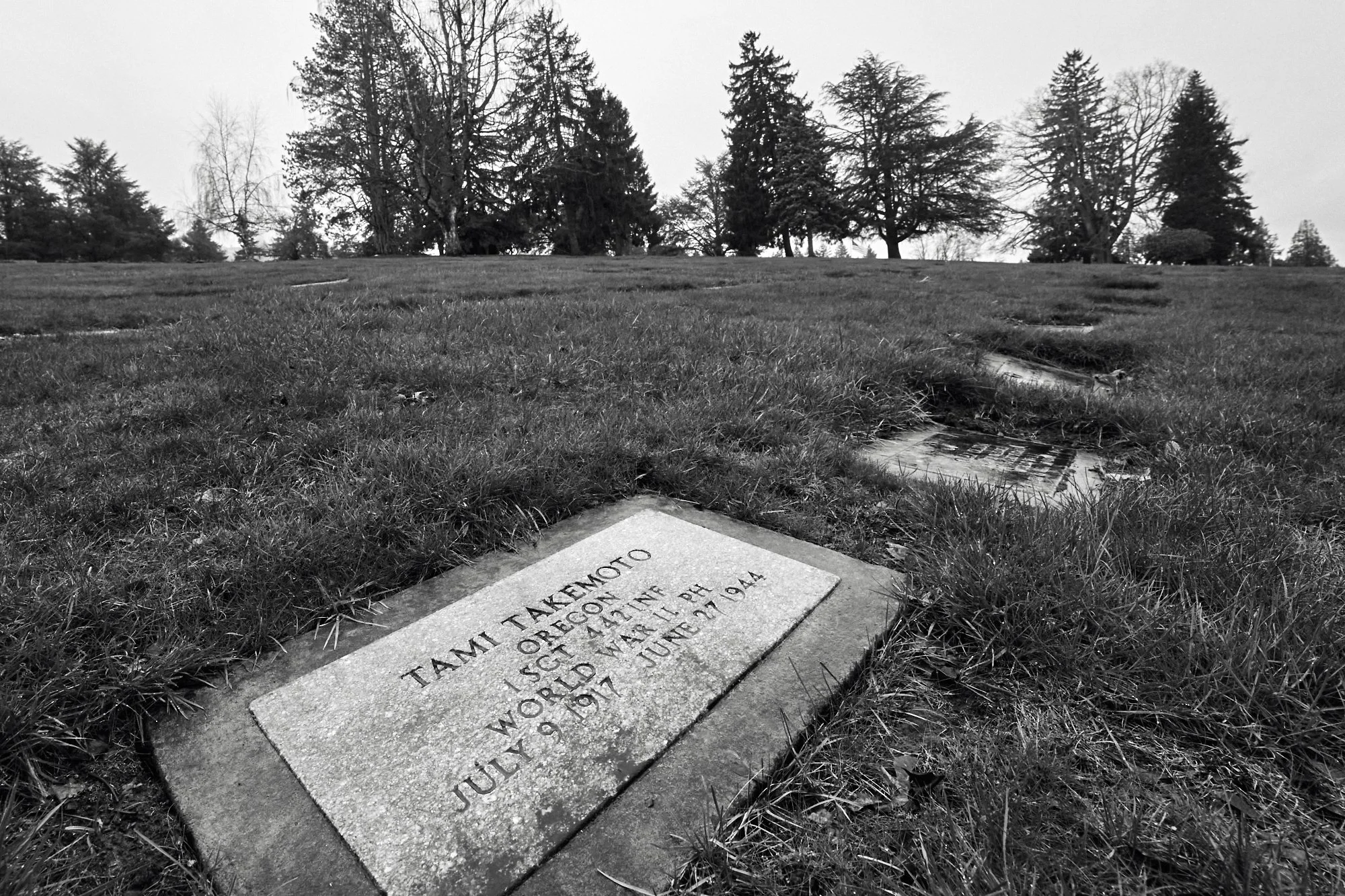
Sunset - The Grave of Sgt Tami "Tom" Takemoto, Lincoln Memorial Park Cemetery
Sony A7iii w/Sony 12-24mm f2.8
ISO4000, 1/30, f10, 14mm
Processed in Capture One 20
It's overcast, as I have come to expect from Portland Oregon on the Solstice, but the far corner of Sgt Takemoto's headstone almost perfectly points to where you would see the sun if not for the cloud cover.
As the sun sets on the dying year, I am almost exactly forty five and a half years old, which means that I grew up in a nation and world defined by the Second World War, and the people whose lives were shaped by the events surrounding it.
Though I have been a polytheistic pagan for my entire adult life, Judaism is my milk religion. I was learning about the horrors of Nazi genocide while my age was still in the single digits, and grew up surrounded by survivors of Nazi labor and extermination camps. My mother's father was a stateside soldier during the war, while my father recalled only finding out where one of his uncles was when he was spotted in the background of newsreel footage of soldiers in combat. My step-father's father fought his way across fortress Europe as an artillery loader. We only found out in the last months of his life that he was present at the liberation of at least one Nazi concentration camp. But we know that the trauma of the war, and that event in particular, shaped the man he was.
As the sun sets on the dying year, it is also quite literally setting on the generation of Americans who fought, and often died, fighting against fascism and authoritarianism in Europe and Asia.
The Veterans' Plot of Lincoln Memorial Park is full of stories (many linked helpfully by the volunteers who submit information to Find A Grave - https://www.findagrave.com/). There are men who were killed during the landings at Normandy and fighting to take Okinawa, soldiers who died outside of combat, from loading ammunition to car crashes and even swimming accidents. There are pilots lost in combat and training accidents. And there are so, so many soldiers whose deaths we know only scant details about, other than "killed in action."
As long as I've been on Earth, living up to the sacrifices of these men and women (yes, women sacrificed during the war, including many lost to enemy action) has been an ideal held by the mainstream of American culture and politics. To be clear, this nation has often and repeatedly failed to live up to that ideal, but the striving was a near universal value.
However, as I took this photo, the sun was setting on a year in which an embrace of fascism and authoritarianism has become mainstream in American politics. The evening of the Winter Solstice, the Vice President of the United States was giving a speech at a conference for a leading conservative organization in which he stated unambiguously that the U.S. is a Christian nation, and proudly spouted talking points that until recently had been the sole province of white nationalists and neo-Nazis.
I can't help but think that the loss from living memory of the generation that sacrificed so deeply, and invested so much of their identities in the fight against fascism, has helped enable this moment.
Which brings us to this photo, and to Sgt Tami Takemoto in particular.
Sgt Takemoto was a member of the 442nd Infantry Regiment. The 442nd was largely made up of Nisei, U.S. born children of Japanese immigrants. You may have heard of the 442nd because it is the most decorated unit in U.S. military history, or because it is the unit that Senator Daniel Inouye (9/7/24 - 12/17/12) was serving in when his actions earned him a Medal of Honor and cost him an arm.
Tami Takemoto's medals, the Bronze Star, Purple Heart, Good Conduct, American Campaign, European-African-Middle Eastern Campaign with one bronze star, World War II Victory, Combat Infantryman Badge, and the the Congressional Gold Medal he received in 2010 with the rest of the 442nd, were largely awarded posthumously. From what I can gather, he was among the first soldiers to join the 442nd, and died soon after the unit began combat operations in Italy.
Like another Nisei who served in the 442nd and is buried nearby, Pvt Roy Naemura (5/14/25 - 4/15/45) who was awarded the Silver Star for gallantry; Sgt Takemoto's family was imprisoned in the Minidoka War Relocation Center, an internment camp for Japanese Americans located in Hunt, Idaho at the time of his death.
Tami Takemoto was initially buried in Europe, but his family elected to have his body returned to where he was born, and interred in the cemetery where I photographed his headstone. His funeral was performed at a local Masonic Temple by four Buddhist priests and attended by the governor of Oregon.
Today, the Vice President of the United States wouldn't consider him a "real" American because of his race and faith. I can think of nothing that better encompasses the year gone by.
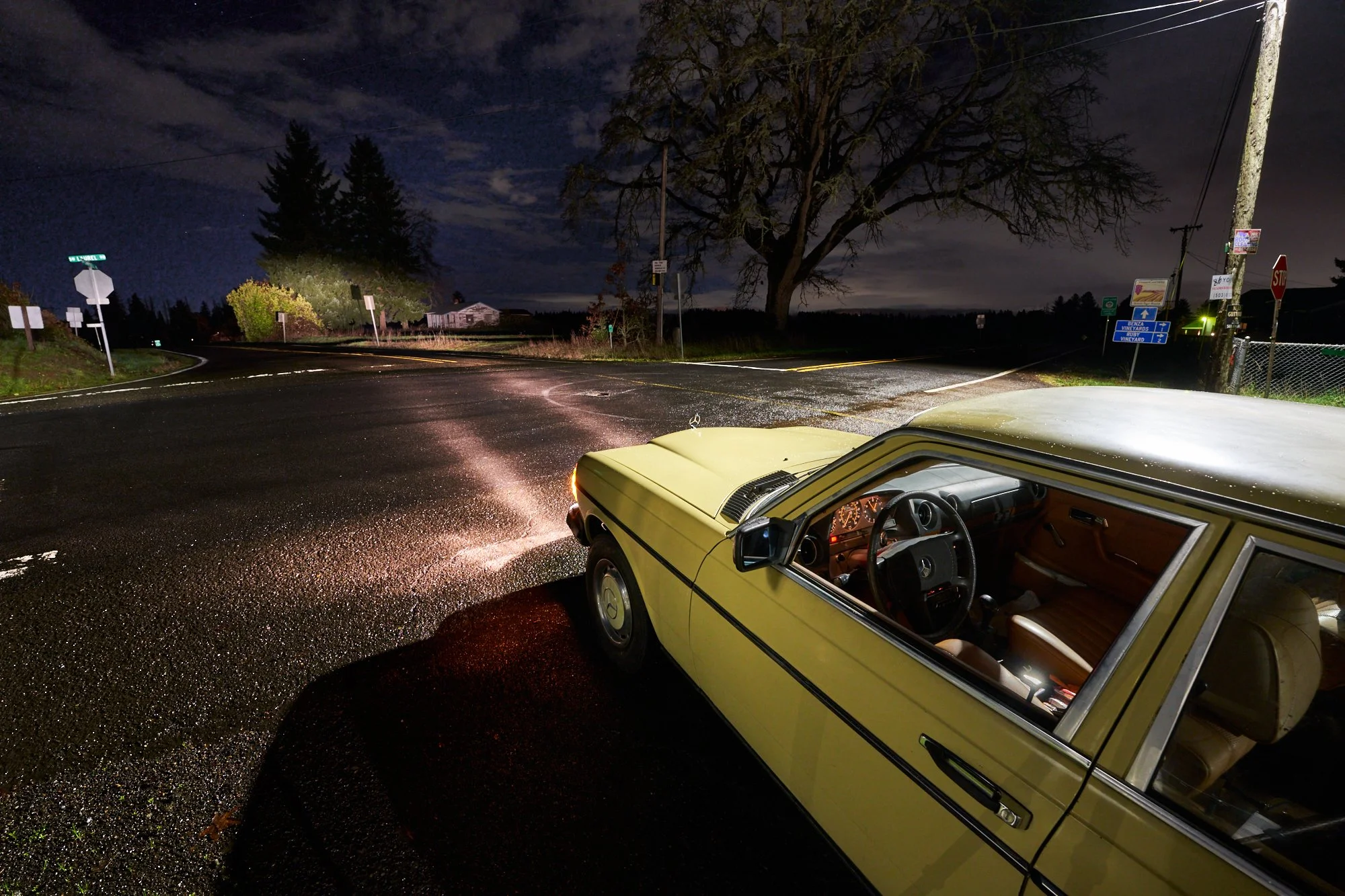
Deep of the Night - The Old Merc & The Crossroads
Sony A7iii w/Sony 12-24mm f2.8
ISO640, 3.2s, f7.1, 14mm
Processed in Capture One 20
This year, there was nowhere that made more sense for me to take my deep of the night photo than at a crossroads. In folklore and mythology, crossroads are often seen as liminal spaces themselves, being a place where the various worlds may touch or collide. The crossroads have been sacred to many different spiritual traditions and deities over the centuries, and played a role in a diverse range of folk traditions.
Many western traditions and legends hold that if you want to summon a demon, finding the right crossroad is an important step. They have been the site of burials and offerings to deities. Some traditions use the concept of the crossroads as a foundational element of their cosmology. And of course, more modern legends tell of the crossroads as a place to make deals and bargains with otherworldly Powers, if you're willing to risk your soul that is.
They also represent the very idea of having choices, or decisions that have to be made.
Last year's Solstice essay was all about having hope in a world that was growing increasingly hostile and giving good reasons for people like my family and I to fear for our future. The year that I watched die while standing by Pvt Takemoto's grave has proven those fears to be well founded. The U.S. government has undertaken a concerted attack on the rights and societal standing of trans people. The administration has declared repeatedly in words and deeds that this country is by and for Christians, which we are not. And a fervor for eugenics has taken hold on the cultural imagination and policy machinery that rightly terrifies me as someone with a highly visible neurological disorder that has been singled out as a target from the podium of the White House Press Room.
It's a year later, and my family is largely out of hope. So much damage has already been done, and there's been such a dramatic shift of the Overton Window over the last year, that the year to come fills me overwhelmingly with dread.
A few days ago, a woman born in Maryland, the state where my husband grew up, was deported by the government, which insisted that her legal documents showing that she was a citizen were false. This was despite the hospital and county where she was born confirming that she had been issued a U.S. birth certificate. Even being a citizen of the United States no longer carries any particular protection against being disappeared to a brutal prison camp, be it in a foreign country or right here at home.
I know how this story unfolds from here.
And so we find ourselves at our own crossroads. We are trying to find a path out of the U.S. But we're middle aged queers. My husband and I both have bachelor's degrees and diabetes. He's trans. I have pretty severe Tourette Syndrome, and spent twenty years working as a professional in kink/BDSM education and event production. Our housemate, who is very much a part of our family, doesn't have any legal ties to us. We only speak English. We have good jobs, but not the kind that are in high demand elsewhere.
In short, we aren't the sort of folk other countries are falling all over themselves to take in. Which brings us back to the crossroads, a place where the worlds touch and decisions have to be made.
My housemate and I found ourselves at this particular crossroads in Chester, the 1978 Mercedes 240D we brought home last solstice, and which was the subject of last year's Deep of the Night photo. Over the past year we've put a lot of hard work and a decent bit of money into Chester. He's been a great project, and a good driving car that bailed us out of trouble more than once when issues sidelined our daily drivers for one reason or another. Having Chester to work on has been good for our mental health too. The slow steady process of bringing him back to life has, as hoped for last year, given us a sense of power over something at a time when we feel generally helpless in the face of a world turning against us.
But we don't know if there's room for project cars and other frivolities in the year to come. If we're going to get out, we have to basical commit to liquidating our entire lives, from our cars to my camera gear to my mom's wedding ring, if it'll free up enough funds to make us appealing enough to a nation that isn't posting Christian Nationalist memes on its official government accounts, actively stripping trans people of rights, and sending innocent people, both citizens and non citizens, to torture camps.
On the other hand, we know that even with all of that, it likely won't be enough. So there's another path we can take, which is to hunker down and try to live our lives as they are for as long as we can, and let the future unfold as it will. Maybe It Will Happen, and that could change the course our country is set on, but I suspect it wouldn't.
Choices will have to be made in the year to come, and where our road takes us is very much dependent on choices and paths set by others, an uncomfortable state of affairs that weighed heavily on me in the deepest part of the Long Night.
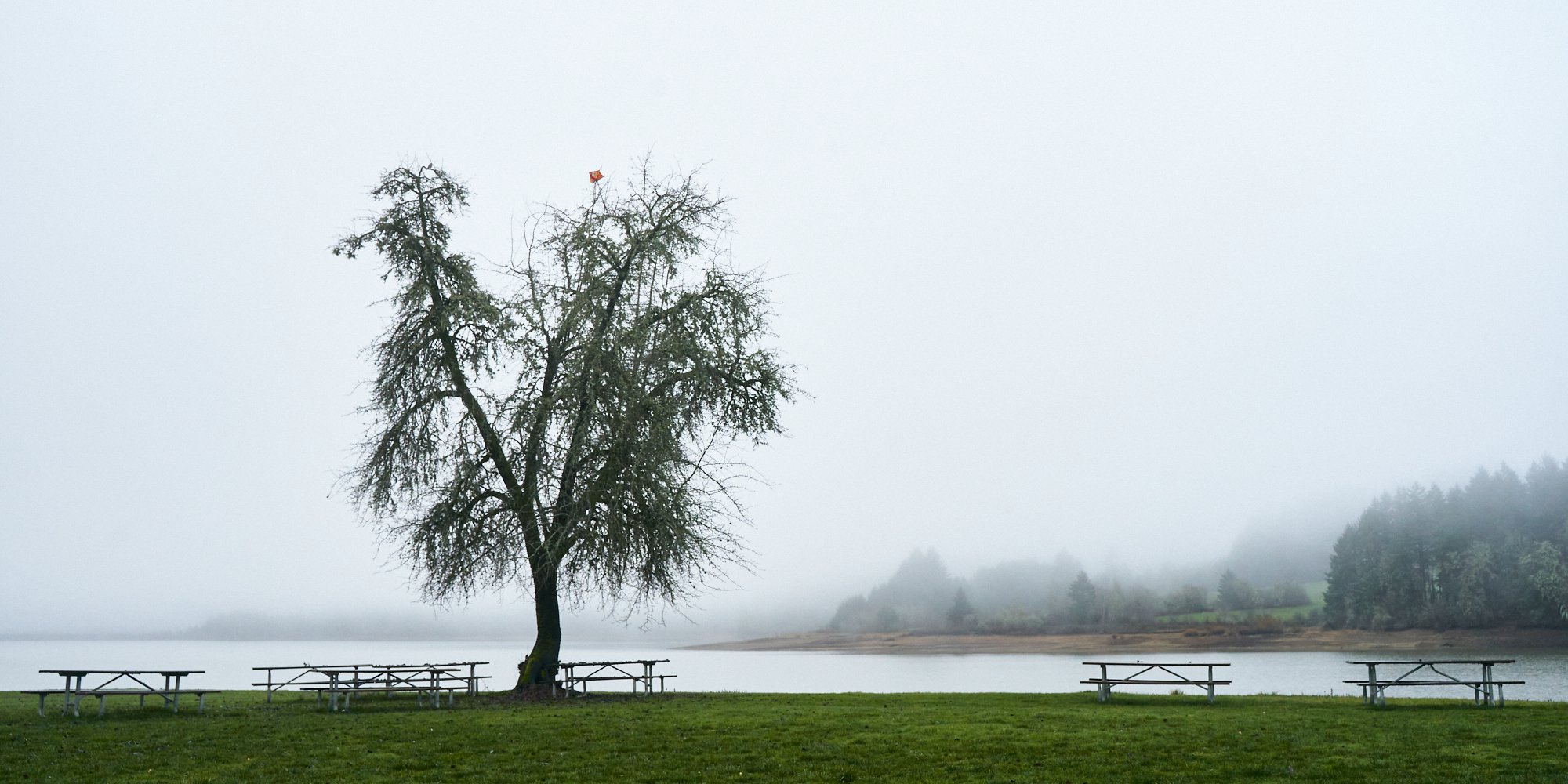
Sunrise - Foggy Morning at Henry Hagg Lake
Sony A7iii w/Tamron 28-75mm f2.8
ISO2000, 1/125, f7.1, 32mm
Processed in Capture One 20
The first sunrise of the waxing year finds me at Henry Hagg Lake, about an hour west of Portland. It is, to the surprise of no one, foggy and overcast. But I find I don't mind.
It is peaceful and still out at the lake. My husband, who drove me since at that point I hadn't slept for more than twenty four hours, and I were unsurprisingly the only people present. He stayed in the nice warm car while I spent about half an hour taking photos, and I quite enjoyed the quiet solitude.
Even with all the fear and anxiety that the dawning year brings, I couldn't help but feel joy and wonder at having endured through the passing of another Long Night. As the sky lightened and the air subtly warmed with the rising of the unseen sun, my fatigue fell away for a moment and I felt unencumbered joy in simply being in that place and time, getting to indulge in my art.
I haven't been able to spend much time taking photos the last few years, as what was once a career has become an infrequently indulged in hobby under economic pressures, and the erosion of society's valuing of photography as an art form.
In fact, if you've been reading my Solstice vigil essays for a long time, you might note that this is the first year in which none of the photos have been processed using Adobe Photoshop. I ended my Photoshop subscription recently, not because of the cost, which was not unreasonable for my use. Rather, I maintain a stance against supporting generative AI.I personally see Adobe's heavy investment in AI as the "future" of creative endeavors as a betrayal of the artists on whose backs Adobe built its empire, and whose work Adobe ingested, remixed, and now is reselling as AI slop while charging us for the privilege.
Had I still been working professionally as a photographer I would have ended my Photoshop subscription sooner if anything.
I spend a good deal of my spare moments writing these days. And though none of those projects have gone anywhere yet, and while writing is as infested and corrupted by generative AI as photography, having a creative outlet of some sort continues to be central to my wellbeing and identity. Still, it's likely a factor in why this year's essay is as wordy as it is. Though that could equally be down to how tumultuous the year gone by has been, and how fraught the year to come surely will be.
This Winter Solstice Vigil project, now in its ninth year, has always been about carrying hope and light through the long night. The deep of the night photo in particular has specifically been about holding light against the encroaching darkness, a visual theme carried through this year, but not in the hopeful way it has been in years gone by.
I wanted to present a journey of light and hope through the long night, but in the end, while I hope other people read and find something meaningful in these yearly pieces, I have to be true to myself and my experience. Reality is that this year hope was scant, and the darkness pressed in on me in new and terrifying ways.
So here's the one piece of hope I had as I watched the sky lighten with the dawn of the new year: I hope that when this year dies and the new one is born, I will still be here, with the capacity to honor the Long Night and craft a photo and essay for the tenth anniversary of starting this project.
Wintersong Tashlin
Tigard, Oregon
Dec 25th 2025